Aims And Scope
AIMS AND SCOPE
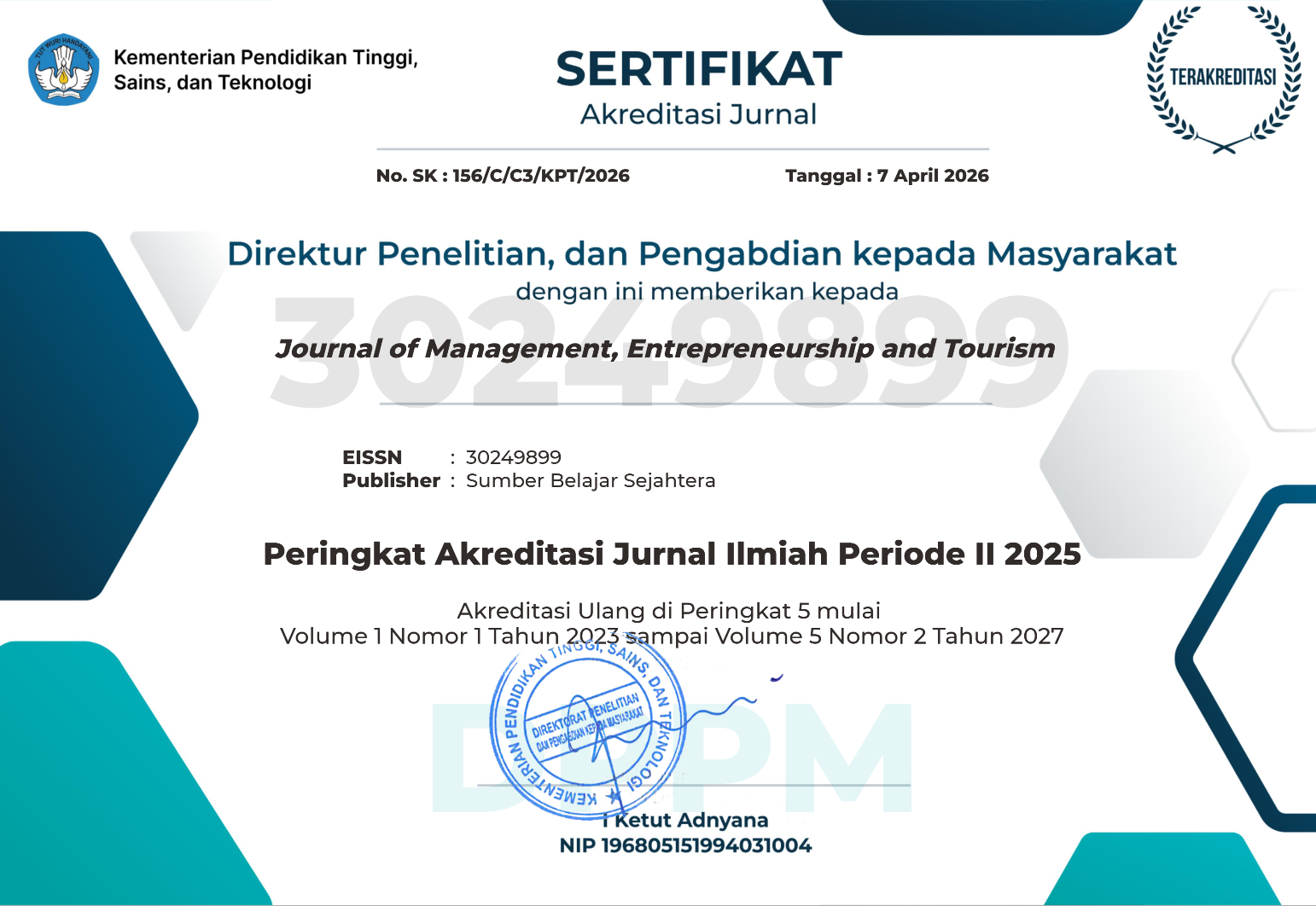
Journal of Management Entrepreneurship and Tourism (JMET)
The Journal of Management Entrepreneurship and Tourism (JMET) is an international, peer-reviewed, open-access scholarly journal dedicated to advancing theoretical, empirical, and applied knowledge in Management and Business, Entrepreneurship and Innovation, and Tourism and Hospitality.
JMET provides a scholarly platform for researchers, academics, practitioners, entrepreneurs, policymakers, and professionals to disseminate rigorous and original research addressing contemporary and emerging issues within these fields.
The journal particularly welcomes research that demonstrates a clear academic contribution, methodological rigor, international relevance, and practical or policy significance.
AIMS
JMET aims to:
-
Advance theoretical and empirical knowledge in management, entrepreneurship, tourism, and hospitality;
-
Publish original and methodologically rigorous research that contributes meaningfully to international scholarly discussion;
-
Encourage the development, testing, extension, integration, and critical evaluation of theories relevant to the journal's core disciplines;
-
Promote research addressing contemporary transformations in business, entrepreneurship, tourism, and hospitality;
-
Provide an international forum for research originating from both developed and emerging economies;
-
Encourage interdisciplinary research where the principal scholarly contribution remains clearly connected to the journal's core fields;
-
Strengthen the relationship between academic research and managerial, entrepreneurial, tourism, hospitality, and policy practice;
-
Promote responsible and forward-looking scholarship addressing innovation, digital transformation, sustainability, resilience, artificial intelligence, circular economy, and inclusive economic development;
-
Support research with meaningful theoretical, managerial, entrepreneurial, societal, or policy implications;
-
Increase the international visibility, accessibility, and scholarly impact of high-quality research in the journal's areas of specialization.
CORE SCOPE
JMET is organized around three primary scholarly domains.
1. Management and Business
JMET welcomes original research that advances understanding of organizations, management practices, business strategies, organizational capabilities, markets, and business performance.
Relevant topics include, but are not limited to:
-
Strategic Management
-
Human Resource Management
-
Organizational Behavior
-
Leadership and Organizational Development
-
Marketing Management
-
Consumer Behavior
-
Financial Management
-
Operations Management
-
Supply Chain Management
-
Innovation Management
-
Knowledge Management
-
Quality Management
-
Organizational Learning
-
Change Management
-
Corporate Governance
-
International Business
-
Small and Medium Enterprise Management
-
Family Business
-
Sustainable Business
-
Responsible Management
-
Business Model Innovation
-
Organizational Agility
-
Organizational Resilience
-
Dynamic Capabilities
-
Risk Management
-
Digital Business Transformation
-
Business Analytics and Decision-Making
-
Service Management
-
Customer Experience
-
Business Competitiveness
-
Strategic Foresight
Research submitted within this domain should offer a clear contribution to management or business scholarship rather than merely describing the activities of an organization.
2. Entrepreneurship and Innovation
JMET publishes research that advances theoretical and empirical understanding of entrepreneurship, entrepreneurial behavior, innovation, new venture development, and entrepreneurial ecosystems.
Relevant topics include:
-
Entrepreneurial Intention and Behavior
-
Entrepreneurial Orientation
-
Entrepreneurship Education
-
Entrepreneurial Ecosystems
-
New Venture Creation
-
Startup Development
-
Small and Medium Enterprises
-
Social Entrepreneurship
-
Sustainable Entrepreneurship
-
Green Entrepreneurship
-
Digital Entrepreneurship
-
Technology Entrepreneurship
-
Regenerative Entrepreneurship
-
Tourism Entrepreneurship
-
Women Entrepreneurship
-
Youth Entrepreneurship
-
Rural Entrepreneurship
-
Family Entrepreneurship
-
Entrepreneurial Leadership
-
Entrepreneurial Resilience
-
Entrepreneurial Self-Efficacy
-
Opportunity Recognition
-
Entrepreneurial Finance
-
Entrepreneurial Marketing
-
Entrepreneurial Networks
-
Business Model Innovation
-
Innovation Capability
-
Open Innovation
-
Social Innovation
-
Green Innovation
-
Creativity and Innovation
-
Institutional Environments for Entrepreneurship
-
Entrepreneurship Policy
JMET particularly welcomes entrepreneurship research that explains mechanisms, processes, antecedents, outcomes, or boundary conditions, rather than studies that provide only descriptive evidence.
3. Tourism and Hospitality
JMET welcomes theoretically informed and methodologically rigorous research that advances tourism and hospitality scholarship.
Relevant topics include:
-
Tourism Management
-
Hospitality Management
-
Destination Management
-
Destination Competitiveness
-
Destination Branding and Marketing
-
Tourism Entrepreneurship
-
Tourism Innovation
-
Sustainable Tourism
-
Responsible Tourism
-
Regenerative Tourism
-
Community-Based Tourism
-
Ecotourism
-
Rural Tourism
-
Cultural and Heritage Tourism
-
Creative Tourism
-
Halal Tourism
-
Sport Tourism
-
Event Tourism
-
MICE Tourism
-
Digital Tourism
-
Smart Tourism
-
Tourist Behavior
-
Tourist Experience
-
Tourist Satisfaction and Loyalty
-
Tourism Destination Resilience
-
Tourism Crisis Management
-
Tourism Planning and Development
-
Tourism Policy and Governance
-
Tourism Technology
-
Hotel Management
-
Restaurant and Food-Service Management
-
Hospitality Service Quality
-
Tourism Human Resource Management
-
Tourism Sustainability
-
Circular Economy in Tourism
-
Community Participation in Tourism Development
Studies conducted in tourism destinations must make a substantive contribution to tourism or hospitality knowledge. Merely using a tourism destination as the geographical location of a study is not sufficient for scope alignment.
CROSS-CUTTING AND EMERGING RESEARCH THEMES
JMET particularly encourages research addressing emerging transformations that intersect with its core disciplines.
Digital Transformation and Artificial Intelligence
Relevant areas include:
-
Artificial Intelligence in Business
-
Generative AI
-
AI-Enabled Entrepreneurship
-
AI in Tourism and Hospitality
-
Digital Transformation
-
Digital Capability
-
Digital Platforms
-
Digital Marketing
-
E-Commerce
-
FinTech
-
Digital Payments
-
Smart Tourism
-
Business Analytics
-
Technology Adoption
-
Platform Entrepreneurship
Sustainability and Responsible Development
Relevant topics include:
-
Sustainable Business Models
-
Circular Economy
-
Green Innovation
-
Environmental, Social, and Governance (ESG)
-
Corporate Social Responsibility
-
Sustainable Entrepreneurship
-
Regenerative Entrepreneurship
-
Sustainable Tourism
-
Regenerative Tourism
-
Responsible Consumption
-
Climate Resilience
-
Green Management
-
Responsible Business
Innovation, Resilience, and Organizational Transformation
The journal welcomes research relating to:
-
Organizational Innovation
-
Dynamic Capabilities
-
Organizational Agility
-
Organizational Resilience
-
Innovation Ecosystems
-
Strategic Foresight
-
Organizational Learning
-
Knowledge-Based Capabilities
-
Business Model Transformation
-
Digital Organizational Transformation
Inclusive and Local Economic Development
Relevant topics may include:
-
MSME Development
-
Inclusive Entrepreneurship
-
Women and Youth Entrepreneurship
-
Rural Entrepreneurship
-
Community Enterprises
-
Creative Economy
-
Social Innovation
-
Local Economic Development
-
Community-Based Tourism
-
Entrepreneurship in Emerging Economies
Such research must maintain a clear scholarly connection to management, entrepreneurship, tourism, or hospitality.
INTERDISCIPLINARY RESEARCH
JMET welcomes interdisciplinary research involving areas such as economics, technology, sustainability, psychology, sociology, education, public policy, and environmental studies only when the manuscript makes a clear and substantive contribution to one or more of JMET's core disciplinary areas.
An interdisciplinary manuscript should clearly explain:
-
Its relevance to JMET;
-
The theoretical relationship with the journal's core disciplines;
-
The specific scholarly contribution made to management, entrepreneurship, tourism, or hospitality.
The presence of a business organization, entrepreneur, MSME, or tourism location alone does not automatically establish relevance to JMET.
INTERNATIONAL ORIENTATION
JMET seeks to publish research that is meaningful to an international academic and professional audience.
The journal welcomes submissions from researchers worldwide and particularly encourages:
-
International research collaboration;
-
Cross-country studies;
-
Comparative research;
-
Research from emerging economies;
-
Studies from underrepresented geographical contexts;
-
Research examining internationally relevant business and tourism challenges;
-
Studies testing established theories in theoretically meaningful new contexts.
Single-country or local studies are welcome when they provide findings or theoretical insights that extend beyond the immediate study location.
Geographical novelty alone is not considered sufficient scholarly contribution.
METHODOLOGICAL SCOPE
JMET welcomes rigorous research using appropriate methodological approaches, including:
-
Quantitative Research
-
Qualitative Research
-
Mixed-Methods Research
-
Experimental and Quasi-Experimental Research
-
Longitudinal Studies
-
Comparative Research
-
Case Studies
-
Multilevel Research
-
Structural Equation Modeling
-
Econometric Analysis
-
Advanced Statistical Modeling
-
Machine Learning and Business Analytics
-
Systematic Literature Reviews
-
Meta-Analysis
-
Bibliometric Analysis
-
Conceptual Research
-
Theoretical Research
The use of an advanced statistical or analytical technique alone does not constitute sufficient contribution.
Methods must be appropriate to the research question and accompanied by meaningful theoretical or substantive interpretation.
TYPES OF ARTICLES
JMET primarily considers the following categories of manuscripts:
Original Research Articles
Original empirical research that presents rigorous analysis and a clearly articulated contribution to knowledge.
Review Articles
Systematic reviews, meta-analyses, bibliometric reviews, and critical integrative reviews that synthesize existing scholarship and provide substantive theoretical insights or future research directions.
Conceptual and Theoretical Articles
Manuscripts that develop, integrate, extend, refine, or critically examine theories, models, or conceptual frameworks.
Case Studies
Rigorous case-based investigations that generate meaningful theoretical, managerial, entrepreneurial, tourism, hospitality, or policy insights.
EXPECTED SCHOLARLY CONTRIBUTION
Manuscripts submitted to JMET should clearly demonstrate what new knowledge they contribute to the field.
A meaningful contribution may include:
-
Developing a new theoretical explanation;
-
Extending or refining an established theory;
-
Identifying a new mechanism or process;
-
Testing meaningful boundary conditions;
-
Reconciling contradictory findings;
-
Developing or validating new constructs;
-
Providing robust evidence concerning an unresolved scholarly question;
-
Integrating previously disconnected streams of literature;
-
Generating meaningful managerial or policy insights supported by rigorous evidence.
Merely repeating an established model in a different location or population, without a meaningful theoretical or substantive contribution, will generally not be sufficient.
Similarly, the use of a new statistical technique does not by itself constitute novelty.
OUT OF SCOPE
To maintain a clear scholarly identity, JMET normally does not consider manuscripts whose primary contribution lies outside management, entrepreneurship, tourism, or hospitality.
Examples normally considered outside the journal's scope include:
-
General education studies without a clear entrepreneurship, business, management, tourism, or hospitality contribution;
-
Pure linguistics and language-learning studies;
-
General psychology without organizational, consumer, entrepreneurial, or tourism relevance;
-
Pure sociology without a substantive connection to the journal's core fields;
-
Clinical and medical research;
-
Nursing research;
-
Dental and health-service research without a clear management contribution;
-
Pure engineering research;
-
Pure computer science or software-development studies;
-
Pure environmental science;
-
Agricultural production studies without agribusiness, management, innovation, or entrepreneurship relevance;
-
General public administration research unrelated to management, entrepreneurship, tourism, or hospitality;
-
Community-service activity reports;
-
Purely descriptive local surveys without substantive scholarly contribution;
-
Studies whose primary contribution clearly belongs to another disciplinary journal.
JMET is not a general multidisciplinary social science journal.
SCOPE CONSISTENCY AND EDITORIAL SCREENING
All submissions are initially evaluated for alignment with the JMET Aims and Scope.
Manuscripts may be declined without external peer review when:
-
The principal research problem falls outside the journal's scope;
-
The manuscript does not demonstrate a meaningful connection to one of the core domains;
-
The contribution is primarily relevant to another discipline;
-
The manuscript is predominantly descriptive and lacks a clear scholarly contribution.
Publication of an isolated interdisciplinary article does not constitute a permanent expansion of the journal's Aims and Scope.
JMET periodically reviews the relationship among its:
-
Aims and Scope;
-
Editorial Board expertise;
-
Reviewer expertise;
-
Submitted manuscripts;
-
Published articles;
-
International developments within its core disciplines.
TARGET READERSHIP
JMET serves an international readership including:
-
Researchers and academics;
-
University faculty;
-
Doctoral and postgraduate researchers;
-
Management and business scholars;
-
Entrepreneurship and innovation scholars;
-
Tourism and hospitality scholars;
-
Entrepreneurs and business leaders;
-
Tourism and hospitality professionals;
-
Policymakers;
-
Government institutions;
-
Research organizations;
-
Professional associations;
-
Other stakeholders interested in evidence-based management, entrepreneurship, innovation, tourism, and hospitality.
EDITORIAL PRIORITY
JMET prioritizes scholarly quality over publication volume.
Manuscripts are evaluated according to:
-
Relevance to the Aims and Scope;
-
Originality;
-
Academic contribution;
-
Theoretical significance;
-
Methodological rigor;
-
Research integrity;
-
Ethical compliance;
-
International relevance;
-
Clarity and readability;
-
Strength of evidence;
-
Quality of discussion and implications.
Alignment with the journal's scope does not guarantee publication.
All manuscripts must satisfy JMET's editorial, ethical, and peer-review standards.
JMET SCOPE AT A GLANCE
Core Domain 1: Management and Business
Core Domain 2: Entrepreneurship and Innovation
Core Domain 3: Tourism and Hospitality
Strategic Cross-Cutting Themes:
Digital Transformation • Artificial Intelligence • Innovation • Sustainability • Circular Economy • Organizational Resilience • Responsible Business • MSMEs • Creative Economy • Regenerative Entrepreneurship • Sustainable Tourism
Journal Orientation: International
Publication Language: English
Peer Review: Double-Blind Peer Review
Primary Contribution Expected: Theoretical, empirical, methodological, managerial, entrepreneurial, tourism, hospitality, or policy advancement