Publication Ethics
JMET EDITORIAL POLICY
Publication Ethics and Malpractice Policy
Journal of Management Entrepreneurship and Tourism (JMET)
The Journal of Management Entrepreneurship and Tourism (JMET) is committed to maintaining integrity, transparency, fairness, accountability, confidentiality, and academic independence throughout the scholarly publishing process.
This policy applies to authors, reviewers, editors, Editorial Board members, the Publisher, and other parties involved in the publication process.
JMET's ethical policies are informed by internationally recognized principles of responsible scholarly publishing, including relevant guidance and core practices of the Committee on Publication Ethics (COPE).
Important Clarification
Reference to COPE guidance does not imply COPE membership unless such membership has been formally obtained and independently verified.
Reference to COPE guidance does not imply COPE membership unless such membership has been formally obtained and independently verified.
I. Core Ethical Principles and Author Responsibilities
Integrity, originality, authorship, accountability, and responsible reporting
1. Core Ethical Principles
JMET is committed to protecting the integrity of the scholarly record.
Editorial decisions are based on:
- Originality;
- Academic contribution;
- Methodological rigor;
- Ethical compliance;
- Relevance to the JMET Aims and Scope;
- Quality and clarity of presentation.
The journal does not tolerate research or publication misconduct. Financial, commercial, institutional, personal, or other inappropriate considerations must not influence editorial decisions.
2. Author Responsibilities
Authors are responsible for ensuring that submitted manuscripts represent accurate, original, ethical, and responsibly conducted scholarly work.
By submitting to JMET, authors confirm that:
- The manuscript is original;
- The work is not simultaneously under consideration by another journal;
- All listed authors have approved the submission;
- Data, analyses, results, and interpretations are reported accurately;
- Sources are appropriately acknowledged;
- Required ethical and legal permissions have been obtained;
- Conflicts of interest and funding have been disclosed;
- All applicable JMET policies have been followed.
Authors remain accountable for the integrity of the work after publication.
3. Authorship and Contributorship
Authorship must reflect genuine and substantial intellectual contribution.
All listed authors should:
- Have contributed meaningfully to the research or manuscript;
- Approve the final version;
- Agree to submission and publication;
- Accept responsibility for their contribution;
- Cooperate in resolving questions concerning the integrity of the work.
JMET does not permit guest authorship, gift or honorary authorship, or ghost authorship.
Contributors who do not meet authorship criteria should be acknowledged appropriately. JMET encourages use of the CRediT Contributor Roles Taxonomy.
4. Changes in Authorship
Authors should finalize the author list and order before submission.
Requests to add, remove, or rearrange authors after submission must:
- Include a clear explanation;
- Be agreed to by all affected authors;
- Be approved by the Editor.
Authorship changes after acceptance will normally be permitted only in exceptional and justified circumstances. Suspected authorship disputes may be referred to the authors' institutions where appropriate.
5. Originality, Plagiarism, and Text Recycling
Manuscripts must constitute original scholarly work.
JMET does not tolerate:
- Plagiarism;
- Unattributed copying;
- Inappropriate paraphrasing;
- Misappropriation of ideas;
- Inappropriate text recycling or self-plagiarism.
Submitted manuscripts may be screened using similarity-detection software or other research-integrity tools.
A numerical similarity score alone does not establish plagiarism. Editorial assessment considers the nature, extent, location, attribution, and context of overlapping material.
6. Duplicate, Redundant, and Overlapping Publication
Authors must not submit substantially the same manuscript to more than one journal simultaneously.
Previously published work must not be presented as original research.
Where manuscripts arise from the same dataset or research program, authors must:
- Disclose related publications;
- Cite relevant previous work;
- Explain the distinct contribution of the submitted manuscript.
Artificial fragmentation of one study into multiple publications without meaningful scholarly justification is discouraged.
7. Preprints and Prior Dissemination
JMET may consider manuscripts previously deposited on legitimate preprint platforms, institutional repositories, or presented as conference abstracts, provided that:
- Prior dissemination is transparently disclosed;
- The manuscript has not already been formally published as the Version of Record;
- Copyright or licensing restrictions do not prevent publication;
- The manuscript satisfies JMET's originality and contribution requirements.
Authors should identify any relevant preprint or prior public version during submission.
II. Research Integrity and Transparency
Data integrity, ethics approval, consent, funding, conflicts, and citation practices
8. Fabrication, Falsification, and Data Manipulation
Authors must not fabricate, falsify, selectively manipulate, or intentionally misrepresent research data, statistical results, qualitative evidence, participant information, images, figures, tables, or analytical outputs.
Where legitimate concerns arise, JMET may request supporting data, documentation, analysis files, or other evidence.
9. Image and Figure Integrity
Images and figures must accurately represent the underlying research.
- Features must not be added, removed, moved, or obscured misleadingly;
- Research images must not be manipulated to distort scientific meaning;
- False empirical images must not be created;
- Copyrighted images must not be reused without required permission.
Uniform adjustments for clarity may be acceptable where they do not misrepresent the underlying information.
10. Research Ethics and Ethical Approval
Research involving human participants, personal data, vulnerable populations, confidential organizational information, animals, or other ethically sensitive materials must comply with applicable ethical standards.
Where required, authors must provide:
- Name of the approving ethics committee or institutional review board;
- Approval number or reference;
- Relevant approval date where applicable.
JMET may request evidence of ethical approval.
11. Informed Consent and Consent for Publication
Authors must obtain informed consent where required.
Special care must be taken with:
- Minors;
- Vulnerable populations;
- Sensitive personal information;
- Confidential organizational or community data.
Authors are responsible for protecting participant privacy and confidentiality.
12. Data Availability and Reproducibility
JMET supports responsible research transparency and reproducibility. Authors should provide a Data Availability Statement where appropriate.
Research data, code, instruments, or related materials should be made available when legally, ethically, and practically possible.
Restrictions based on confidentiality, privacy, institutional agreements, commercial sensitivity, intellectual-property rights, or ethical requirements should be clearly explained.
13. Funding Disclosure
Authors must disclose all relevant financial support, including:
- Funder name;
- Grant number where applicable;
- Relevant role of the funder.
Funding arrangements must not compromise research independence.
14. Conflicts of Interest and Competing Interests
Authors, reviewers, and editors must disclose interests that could reasonably be perceived as influencing their judgment.
Where no relevant conflict exists, authors may state: “The authors declare no conflict of interest.”
15. Citation Ethics
References must be selected for legitimate scholarly reasons.
JMET prohibits:
- Citation manipulation;
- Citation cartels;
- Irrelevant citation padding;
- Excessive self-citation without scholarly justification;
- Coercive citation practices.
Editors and reviewers must not pressure authors to cite their own publications, JMET publications, or unrelated sources solely to increase citation metrics.
III. Peer Review and Editorial Governance
Independent review, editorial responsibility, publisher role, copyright, and AI
16. Peer-Review Integrity
JMET operates a double-blind peer-review process.
Manuscripts passing initial editorial screening are normally evaluated by at least two qualified independent reviewers.
JMET does not tolerate fabricated reviewer identities, fraudulent reviewer accounts, undisclosed reviewer conflicts, reviewer manipulation, or attempts by authors to control the review process.
Reviewer recommendations are advisory. The final editorial decision remains the responsibility of the designated Editor.
17. Reviewer Responsibilities
- Evaluate manuscripts objectively and professionally;
- Maintain confidentiality;
- Declare conflicts of interest;
- Review only within their area of expertise;
- Provide constructive and evidence-based comments;
- Alert Editors to suspected misconduct where appropriate.
Reviewers must not use confidential information for personal benefit, contact authors directly about the review, use inappropriate language, or require irrelevant citations.
18. Editor Responsibilities
Editors must ensure that editorial processes are:
- Fair;
- Independent;
- Confidential;
- Evidence-based;
- Timely;
- Ethically appropriate.
19. Editorial Conflicts of Interest
Editors must not manage manuscripts in which they have a significant conflict of interest. Such manuscripts should be transferred to another qualified and independent Editor.
Manuscripts submitted by Editorial Board members must undergo the same independent peer-review standards applied to other submissions.
20. Editorial Independence
Scientific editorial decisions are made by the Editor-in-Chief and responsible Editors.
The Publisher, Sumber Belajar Sejahtera, provides organizational, administrative, technical, and financial support but does not improperly interfere with scientific editorial decisions.
The following must not influence acceptance or rejection:
- Article Processing Charges;
- Sponsorship;
- Advertising;
- Institutional prestige;
- Commercial relationships;
- Author financial status.
Payment of publication fees does not guarantee acceptance, accelerated review, or favorable treatment.
21. Publisher Responsibilities
The Publisher supports editorial independence, research integrity, digital preservation, accessibility, ethical publishing procedures, and responsible correction of the scholarly record.
The Publisher does not own the copyright of JMET articles, except where an exceptional and explicitly documented arrangement lawfully provides otherwise.
22. Copyright and Licensing
Authors retain copyright in accordance with the JMET Copyright and License Statement.
Published articles are licensed under Creative Commons Attribution-ShareAlike 4.0 International (CC BY-SA 4.0), unless another arrangement is explicitly and lawfully stated.
23. Generative AI and AI-Assisted Technologies
JMET maintains a separate Generative Artificial Intelligence and AI-Assisted Technologies Policy.
- AI cannot be listed as an author;
- Human authors remain fully accountable;
- Substantive AI use must be disclosed;
- Fabricated AI-generated data or references are prohibited;
- Reviewer and editor confidentiality must not be compromised through AI tools.
IV. Misconduct and Post-Publication Actions
Allegations, investigations, corrections, retractions, and appeals
24. Research and Publication Misconduct
Misconduct may include, but is not limited to:
- Plagiarism;
- Fabrication;
- Falsification;
- Data or image manipulation;
- Authorship misconduct;
- Citation manipulation;
- Peer-review manipulation;
- Duplicate publication;
- Copyright infringement;
- Undisclosed competing interests;
- Misrepresentation of ethical approval;
- Paper-mill activity;
- Fraudulent research documentation;
- Inappropriate or undisclosed AI use material to research integrity.
25. Handling Allegations of Misconduct
JMET takes credible allegations seriously whether raised before or after publication.
Concerns may be raised by authors, reviewers, readers, editors, institutions, and anonymous or identified whistleblowers.
The journal may request research data, ethical documentation, authorship records, correspondence, explanations, or other evidence.
The journal will distinguish allegations from established findings and avoid unsupported conclusions.
26. Corrections
Where an error affects accuracy or interpretation but does not invalidate an article as a whole, JMET may issue a Correction, Erratum, or Corrigendum.
- The correction must be clearly identified;
- It must be linked to the original article;
- It must explain what has been corrected;
- It must preserve transparency of the scholarly record.
Material changes should not be made silently.
27. Retractions
Retraction may be considered where reliable evidence indicates that a publication is fundamentally unreliable or involves serious misconduct.
Potential reasons include fabrication, falsification, serious plagiarism, unethical research, duplicate publication, major analytical errors, or compromised peer review.
Retracted articles should normally remain accessible and clearly marked as retracted to preserve the scholarly record.
28. Expressions of Concern
JMET may issue an Expression of Concern where serious questions exist about a publication but evidence remains inconclusive or an external investigation is ongoing.
29. Post-Publication Discussion
JMET welcomes legitimate scholarly discussion concerning published articles.
Readers may report factual errors, methodological concerns, ethical concerns, data-integrity issues, authorship concerns, and other significant matters.
30. Complaints and Appeals
JMET maintains a separate Complaints and Appeals Policy.
Authors may appeal editorial decisions when substantial factual, procedural, ethical, or conflict-of-interest concerns exist.
Individuals who are the subject of a complaint must not exercise sole authority over the outcome. Good-faith complaints must not result in retaliation.
V. Publishing Operations and Scholarly Record
Fees, advertising, confidentiality, preservation, and responsible journal metrics
31. Article Processing Charges and Ethical Independence
Publication charges are disclosed separately in the Article Processing Charges and Author Fees Policy.
Financial arrangements do not influence reviewer selection, peer-review recommendations, editorial assessment, acceptance or rejection, or post-publication ethical decisions.
No fee guarantees publication.
32. Advertising and Direct Marketing
Advertising, sponsorship, and promotional activities must remain separate from editorial decision-making.
Direct marketing must be truthful, relevant, appropriately targeted, professional, and non-misleading.
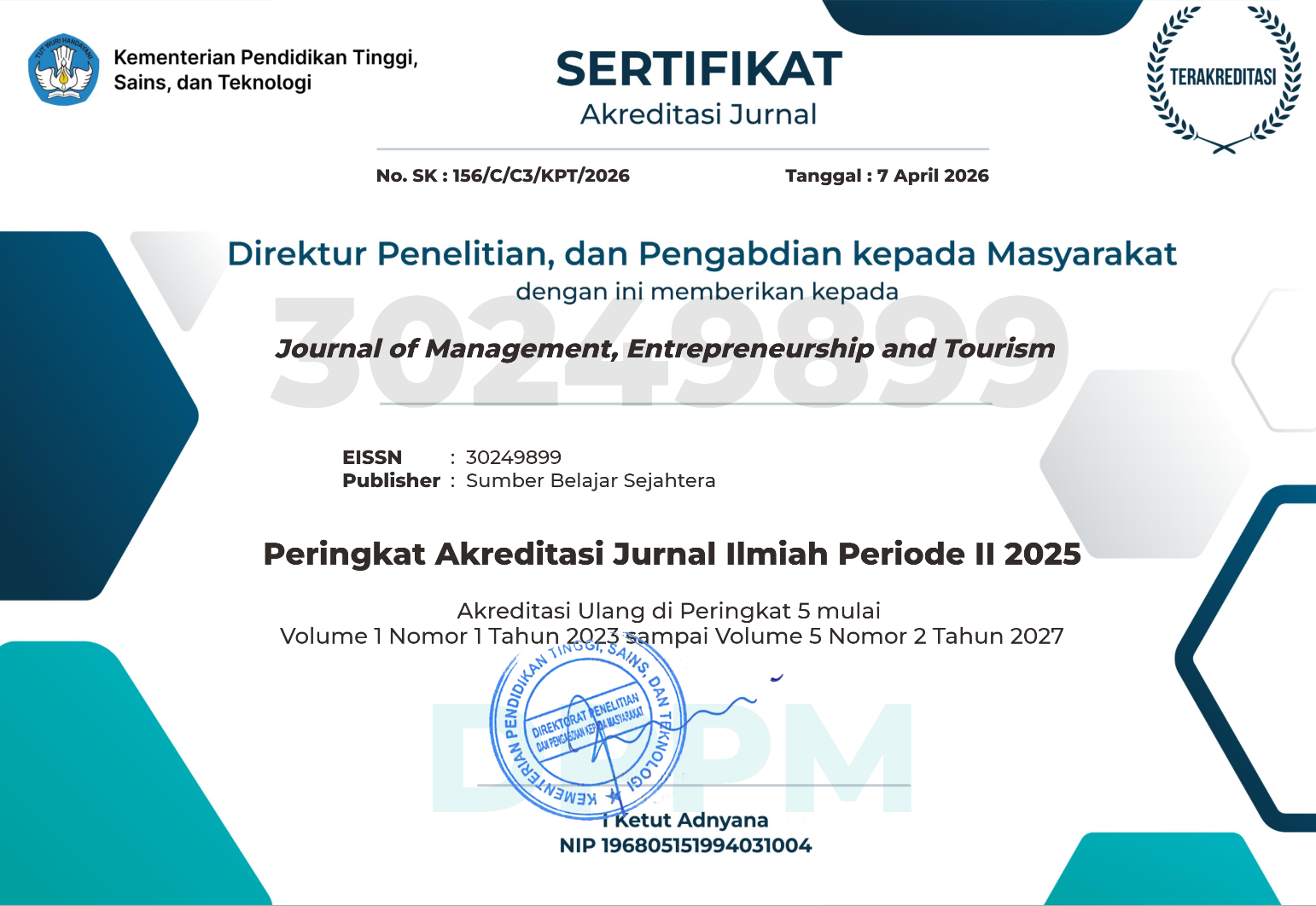
JMET must not misrepresent its indexing status, accreditation, citation performance, journal metrics, or publication status.
33. Confidentiality
JMET maintains appropriate confidentiality of:
- Submitted manuscripts;
- Reviewer identities where required;
- Reviewer reports;
- Editorial correspondence;
- Ethical investigations;
- Unpublished research information.
34. Preservation of the Scholarly Record
JMET is committed to maintaining a reliable and permanent scholarly record.
Corrections, retractions, Expressions of Concern, and related notices form part of that record. Long-term preservation arrangements are described in the journal's Archiving and Digital Preservation Policy.
35. Responsible Journal Metrics
JMET does not manipulate citations, publication volume, peer review, editorial processes, or author networks for the purpose of artificially increasing journal metrics.
The terms indexed in, listed in, cited by, registered with, member of, and under evaluation must be used accurately and must not be presented as equivalent.
VI. Policy Governance
Policy consistency and periodic review
36. Policy Consistency
This policy should be read together with JMET's:
- Author Guidelines;
- Aims and Scope ;
- Peer Review Process;
- Complaints and Appeals Policy;
- Generative Artificial Intelligence Policy ;
- Copyright and License Statement;
- Open Access Statement;
- Archiving and Digital Preservation Policy;
- Article Processing Charges Policy;
- Other applicable journal policies.
Where inconsistencies are identified, JMET will seek to correct them promptly.
37. Policy Review
This policy will be reviewed periodically to reflect developments in:
- Publication ethics;
- Research integrity;
- Artificial intelligence;
- Scholarly communication;
- Data governance;
- International publishing standards.
Material changes will be communicated transparently through the official JMET website.
OFFICIAL ETHICAL COMMITMENT
JMET is committed to safeguarding the integrity of scholarly communication through responsible authorship, independent peer review, transparent editorial processes, ethical research conduct, appropriate handling of misconduct, and preservation of a reliable scholarly record.